
AI was hard to miss at London Tech Week 2026. It was not confined to one stage, one sector or one specialist track. Across the conference floor, panel discussions and networking conversations, AI had become the backdrop to almost every discussion about the future of enterprise technology, public services, data and product development.
But the most useful takeaway was not simply that “AI is everywhere”; it was that the conversation was moving on.
Organisations are no longer only asking whether AI can generate useful outputs. They are asking how those outputs can be turned into something clear, reliable and practical enough to support real decisions.
That shift is where our insights platform, D.A.V.E., fits: helping organisations move beyond raw feedback and survey data towards clearer, faster and more decision-ready insight.
From capability to usable insight
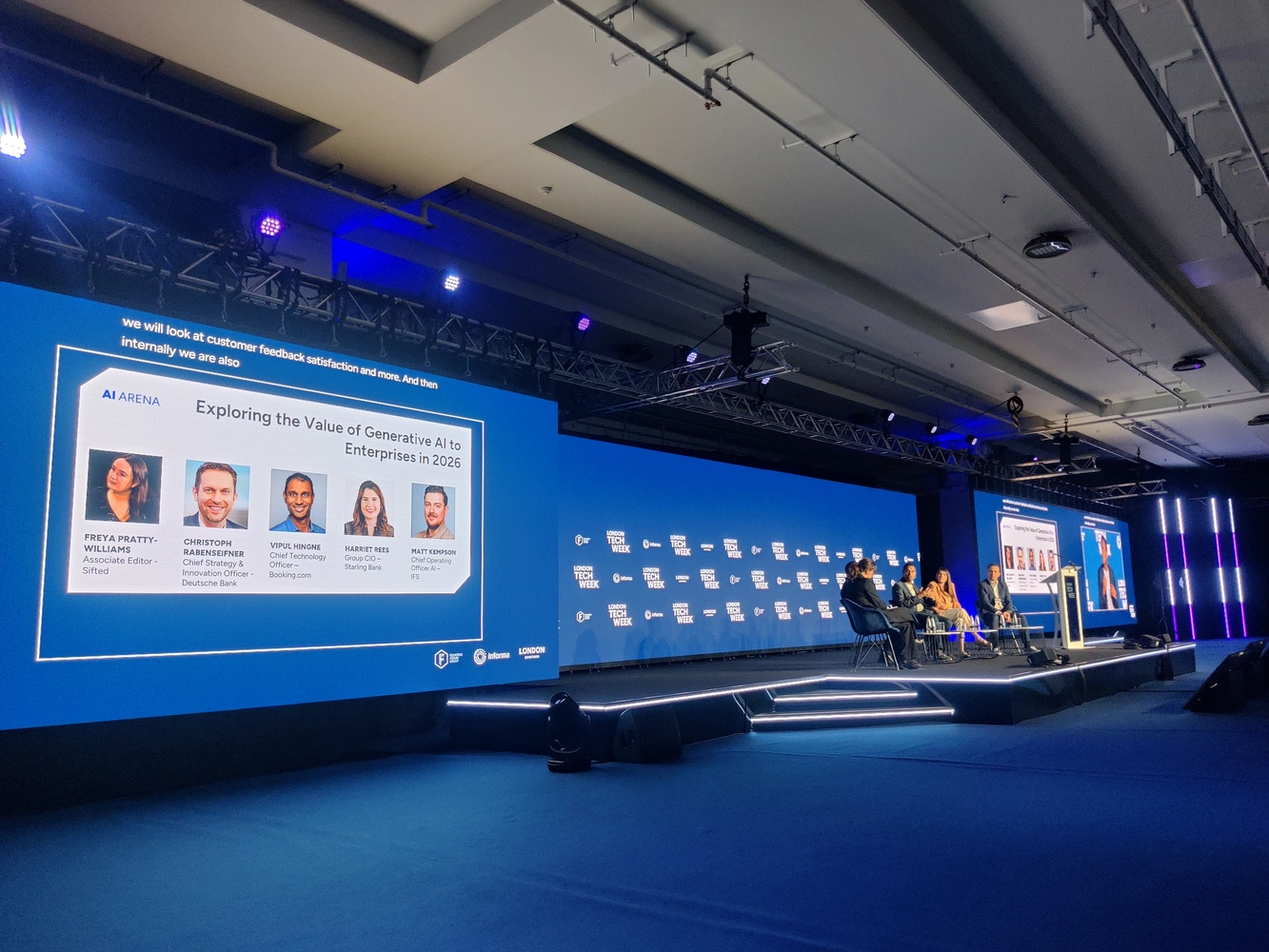
At the AI Arena, a session featuring leaders from Deutsche Bank, Booking.com, Starling Bank and IFS discussed how enterprises are moving generative AI beyond proof of concept toward measurable operational impact.
The discussion reflected a wider pattern across London Tech Week. The bottleneck is rarely model capability. Organisational and human factors are much more critical elements. Care must be taken when redesigning workflows – whether for AI-augmented human teams or, especially, when unleashing autonomous AI agents. Reconsidering leadership, culture, training, governance, data access, and contextual information is also needed in this emerging era of AI-empowered enterprises. A facet of this, which intersects with GoLLM, is how organisations can turn complex data and AI-supported analysis into outputs that are understandable and actionable in practice.
It is not enough for AI to produce a summary, a theme list or a set of suggested findings. For those outputs to matter, they need to help people understand what their data is saying and what are the logical next steps.
That is the gap D.A.V.E. is designed to close.
Beyond AI for AI's sake
One risk in the current market is that “AI” becomes the headline, rather than the value.
London Tech Week made clear just how widely AI is now being discussed across sectors. That is encouraging, but it also raises the bar for product clarity. When every company is talking about AI, the important question becomes: what does the product actually help people do?
For GoLLM, the answer is focused. D.A.V.E. helps organisations make sense of complex qualitative and quantitative feedback data. That might include survey responses, consultation data, stakeholder input, customer feedback or internal engagement findings.
The value is not AI in the abstract. The value is faster analysis, clearer reporting and more decision-ready insight.
Real-world impact needs evidence
This theme ran through much of the week's wider programme. A session titled "Technology in Action: Real-World Outcomes and Impact", hosted under the GREAT Britain & Northern Ireland banner, examined how research moves from the lab into deployable, measurable outcomes.

The panel's framing reinforced a pattern we see consistently in our own work with public- and private-sector clients: real-world impact does not come from experimentation alone. It comes when organisations can embed tools into their workflows, understand the evidence being produced, and use that evidence to make better decisions.
In our own work, we see this challenge especially clearly in feedback analysis. Whether supporting global management consultancies, local government authorities, industry associations, insight consultancies, HR agencies, media companies, or others, the underlying challenge looks remarkably similar.

Organisations often collect large volumes of valuable input, but the process of turning that data into clear findings can be slow, manual and difficult to repeat consistently. It's this gap that D.A.V.E.'s analysis and insights layers are designed to close: taking raw responses and transforming them into structured insight, from scattered themes to clearer evidence and from analysis bottlenecks to practical reporting outputs.
Readiness as the missing link
This is also why GoLLM’s AI Readiness research on local government authorities matters.
We set out to measure how prepared these UK organisations are to move from early experimentation to responsible, practical deployment. Though it investigated the public sector, the findings resonate with the themes raised across sectors at London tech week, from enterprise AI value to real-world deployment – both sit squarely within the same questions the research was designed to answer.
Conversations across the week also reflected the increasingly international dimension of this work, with delegations and discussions spanning multiple countries exploring how policy, investment and innovation are converging around responsible AI development. That global framing matters: deploying AI responsibly isn't a UK-only or single-sector problem. It's a shared one, and the answers will increasingly depend on shared standards of governance and trust.
We'll be picking up this same thread at the CIEH AI & Tech Conference on 1 July, where GoLLM will be presenting findings from our AI readiness research and discussing what they mean for local authorities and other organisations.
The takeaway
London Tech Week 2026 showed that AI is no longer sitting at the edge of the technology conversation. It is becoming part of the operating context for organisations across sectors.
The organisations that move fastest and safest will not simply be those chasing the newest AI capability. They will be the ones able to turn complex data into insight they can understand, trust and act on.
That is where D.A.V.E. is focused: helping organisations move from data and experimentation to clearer, faster and more decision-ready evidence.